

When an electric motor operates in an environment where flammable gases, vapors, combustible dust or other ignitable materials may be present, choosing the right motor involves much more than horsepower, RPM, voltage and frame size.
You also need to understand the hazardous location classification.
Terms like Class I, Division 1, Groups C & D or Class II, Division 1, Groups F & G aren't simply technical language on a motor nameplate. They describe the environment in which the equipment has been evaluated for use.
And while the term "explosion proof" is often used broadly, an explosion-proof motor is not automatically suitable for every hazardous location.
The motor must be appropriate for the specific Class, Division or Zone, Group, temperature requirements and operating environment where it will be installed.
Let's break down what those hazardous location approvals mean—and what you should know when selecting an explosion-proof motor.
What Is a Hazardous Location?
A hazardous location, sometimes called a hazardous area, is an area where flammable or combustible materials may be present in concentrations or quantities that can create a fire or explosion hazard.
Depending on the industrial process, those materials might include flammable gases, vapors, combustible dusts, or easily ignitable fibers and flyings.
Examples can be found throughout industries such as oil and gas, chemical and petrochemical processing, agriculture and grain handling, food processing and other industrial operations.
An ordinary electrical device may generate heat, sparks or other potential sources of ignition during operation or a failure. Hazardous-location requirements are intended to help ensure that the electrical equipment used in these environments is appropriate for the particular hazard.
In North America, hazardous locations have traditionally been identified using a Class, Division and Group classification system. A Zone system may also be encountered for certain installations.
What Does "Explosion Proof" Actually Mean?
One of the most common misconceptions is that an explosion-proof motor is a motor in which an explosion can never occur.
That's not what the term means.
For applicable gas or vapor environments, explosion-proof apparatus is constructed so that its enclosure can withstand an internal explosion of a specified gas or vapor and prevent that event from igniting the specified surrounding atmosphere. External surface temperature is also part of the consideration.
The construction of explosion-proof equipment can therefore involve carefully controlled enclosure joints, flame paths, materials and other design features intended to contain and cool gases produced by an internal ignition before they can ignite the surrounding atmosphere.
The important takeaway is this:
"Explosion proof" describes a protection technique—not universal approval for every hazardous environment.
You still need to know what hazardous material is present and how the location has been classified before determining whether a particular motor is appropriate.
Understanding Class, Division and Group
Think of the traditional North American hazardous-location classification as answering three basic questions:
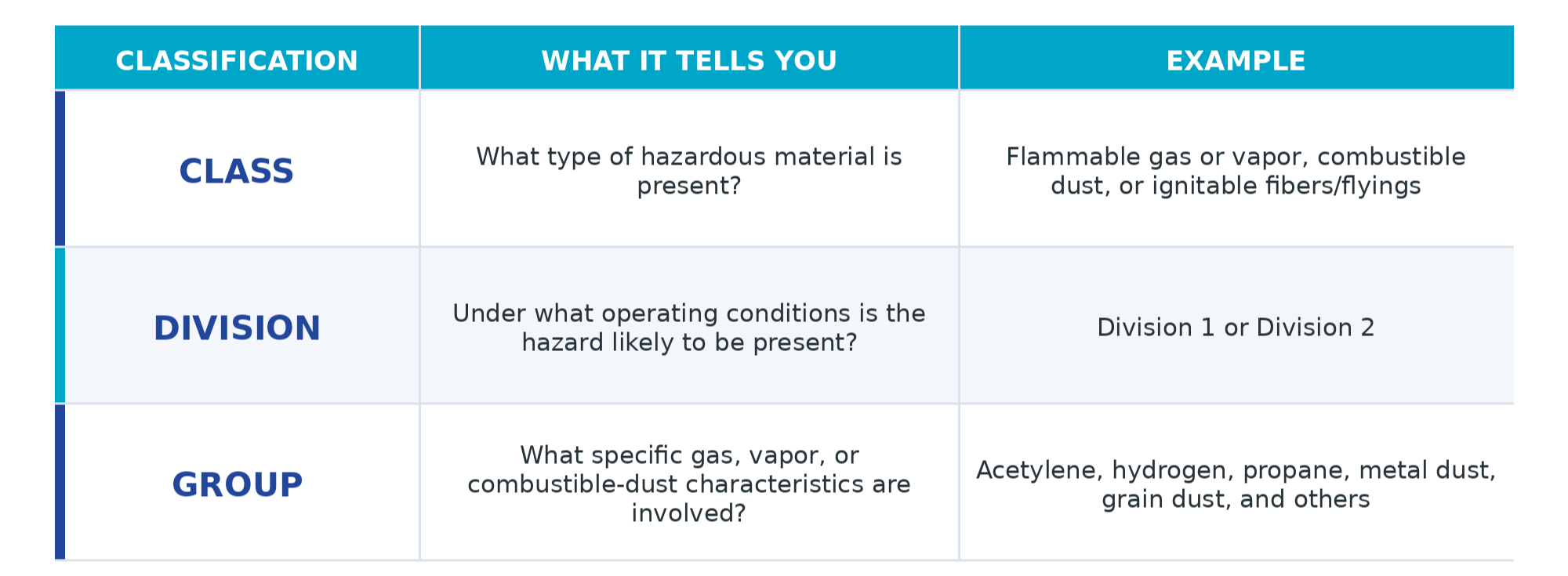
Understanding all three is important when selecting hazardous-location electrical equipment.
CLASS: What Type of Hazard Is Present?
The Class identifies the general type of hazardous material.
Class I: Flammable Gases or Vapors
Class I locations are locations where flammable gases or vapors may be present in quantities capable of producing an ignitable mixture.
Industrial examples can include portions of petroleum facilities, chemical processing operations, paint or solvent handling areas, and other processes involving flammable gases or volatile liquids.
Class II: Combustible Dust
Class II applies to locations that are hazardous because of combustible dust.
Depending on the material and process, examples can include grain handling, flour processing, coal handling and some metal-processing environments.
Combustible dust deserves particular attention because materials that appear relatively harmless in bulk form can behave very differently when finely divided and dispersed in air.
Class III: Ignitable Fibers and Flyings
Class III locations involve easily ignitable fibers or flyings.
These materials aren't necessarily expected to remain suspended in the air in the same way combustible dust can, but their presence around electrical equipment can still create a hazardous condition.
OSHA's hazardous-location definitions distinguish Class I gases and vapors, Class II combustible dusts, and Class III ignitable fibers or flyings.
DIVISION: How Likely Is the Hazard to Be Present?
Once the Class has been identified, the Division helps describe the conditions under which the hazardous material may be present.
Division 1
At a high level, a Division 1 location is one where hazardous concentrations may be present during normal operating conditions, or where certain maintenance, leakage or equipment-failure conditions create the circumstances defined by the applicable classification requirements.
For example, a Class I, Division 1 environment can include a location where ignitable concentrations of flammable gas or vapor may exist during normal operations.
For Class II, Division 1, combustible dust may be suspended in the air in hazardous quantities during normal operations, among other qualifying conditions.
Division 2
Division 2 generally addresses situations where the hazardous material is not normally expected to exist in an ignitable concentration during ordinary operation, but may become present because of an accidental release, equipment failure, ventilation failure or another abnormal condition.
That distinction matters.
A facility shouldn't simply assume that an entire building—or an entire industry—is Division 1 or Division 2. Hazardous-location classification is based on the actual process, materials and conditions in the specific area. OSHA states that each room, section or area is considered individually when determining its classification.
GROUP: Which Gas, Vapor or Dust Is Present?
Two locations can both be Class I, Division 1 while containing very different hazardous materials.
That's where Groups become important.
Under the traditional North American Division system, Class I gases and vapors are divided into Groups A through D, while Class II combustible dusts use Groups E through G.
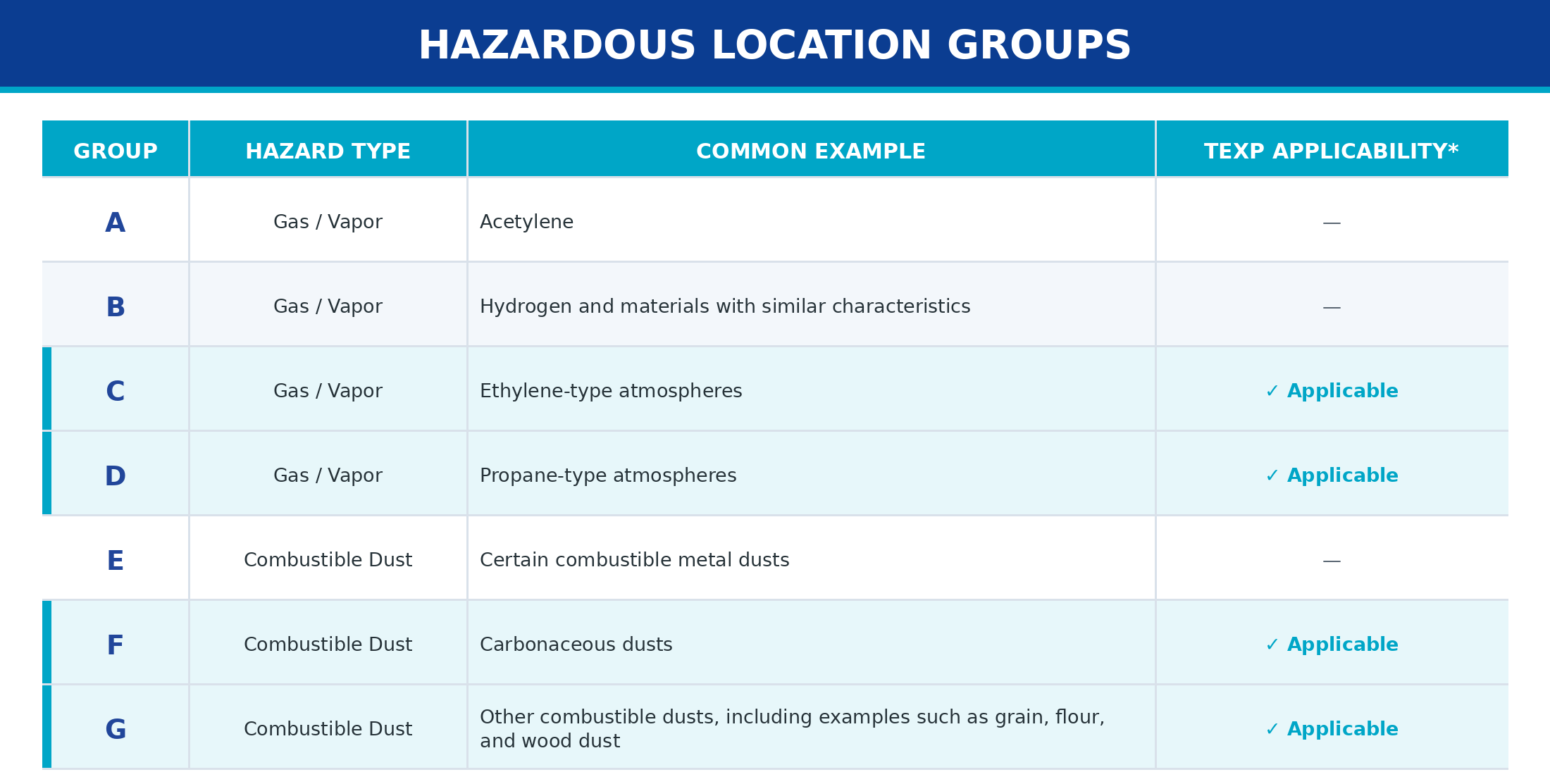
These groups account for differences in the ignition and combustion characteristics of various substances.
For someone selecting an electric motor, this means seeing Class I, Division 1 isn't enough.
You also need to know the applicable Group.
A Class I, Division 1, Group D motor, for example, shouldn't automatically be assumed suitable for a Group B environment simply because both locations are Class I, Division 1.
UL's North American hazardous-area guidance identifies Groups A through D with Class I materials such as acetylene, hydrogen, ethylene and propane, and Groups E through G with metal, carbonaceous and other combustible dusts.
What About Class/Zone Hazardous Locations?
In addition to the traditional Division system, North American installations may use a Zone classification system for applicable Class I gas and vapor locations.
At a simplified level:
Zone 0 describes an area where an ignitable gas or vapor atmosphere is present continuously, for long periods or frequently.
Zone 1 describes an area where an ignitable atmosphere is likely to occur in normal operation.
Zone 2 describes an area where an ignitable atmosphere isn't likely to occur in normal operation and, if it does occur, typically exists for a limited period.
The important thing is not to treat Division and Zone designations as interchangeable labels.
They are different classification systems with their own markings and requirements. When working with an existing facility, replacement motor or engineering specification, use the classification identified for that installation and verify the equipment's actual certification.
Under OSHA's general-industry electrical requirements, Class I installations may be classified using either the Division or applicable Zone classification system.
Don't Forget the Temperature Code
Class, Division, and Group still don't tell the entire story.
Electrical equipment in hazardous locations also needs to be evaluated in relation to temperature.
Every flammable material has thermal characteristics that influence its potential for ignition. Electrical equipment, meanwhile, can produce heat during normal operation.
That's why hazardous-location equipment markings can include a temperature code, commonly called a T-code.
The T-code identifies the equipment's maximum surface temperature under specified conditions. For example, a T3C designation corresponds to a maximum temperature of 160°C under the applicable rating system.
The applicable equipment temperature rating must be appropriate for the hazardous material and conditions involved.
This is one reason why selecting a hazardous-location motor solely by horsepower and enclosure type can create problems. Even if the mechanical dimensions and electrical ratings match, the hazardous-location markings must also be appropriate.
Who Certifies Hazardous-Location Motors?
Another source of confusion involves the relationship between OSHA, the National Electrical Code, UL, CSA and other organizations.
They don't all perform the same role.
The National Electrical Code (NFPA 70) contains requirements addressing electrical equipment and installations, including hazardous classified locations.
OSHA establishes workplace electrical safety requirements and operates the Nationally Recognized Testing Laboratory, or NRTL, program.
Organizations recognized as NRTLs can test and certify products within their recognized scopes. UL Solutions, CSA Group and Intertek are examples of organizations recognized through OSHA's NRTL program.
This is why "UL Listed" and "ETL Listed," for example, shouldn't simply be interpreted as one being a code and the other being a standard.
A code, a product standard, a testing/certification organization and a certification mark are different things.
For the individual responsible for motor selection, what matters most is verifying that the motor carries the appropriate certification and markings required for the installation.
The local Authority Having Jurisdiction (AHJ) and applicable codes should also be considered.
How to Read a Hazardous-Location Motor Nameplate
When evaluating an existing motor or specifying a replacement, the motor nameplate can provide critical information.
Along with familiar electrical and mechanical data such as horsepower, voltage, phase, frequency, RPM and frame size, look closely for hazardous-location information.
Depending on the motor and certification, that may include Class, Division or Zone, Group, temperature code, ambient-temperature limitations and certification marks.
Never assume that two motors with the same horsepower, RPM and frame are interchangeable in a hazardous location.
Their hazardous-location approvals may be very different.
When replacing an existing motor, taking a clear photograph of the complete nameplate can be one of the most useful first steps in the selection process.
A Practical Explosion-Proof Motor Selection Checklist
Before selecting a hazardous-location motor, make sure you can answer these questions:
- What hazardous material is present? Determine whether the concern involves flammable gas or vapor, combustible dust, fibers or another classified hazard.
- What Class applies? Identify whether the location has been classified as Class I, Class II or Class III under the applicable system.
- What Division or Zone applies? Determine the likelihood and operating conditions under which the hazard may be present.
- What Group applies? Identify the specific gas, vapor or dust classification.
- What temperature rating is required? Confirm the T-code and applicable ambient-temperature requirements.
- What motor performance is needed? Verify horsepower, RPM, voltage, phase, frequency, frame, mounting, service factor and load requirements.
- What environmental conditions exist? Consider moisture, corrosion, outdoor exposure, dust, temperature and other site conditions.
- What certification is required? Verify the equipment's actual nameplate and certification documentation.
- What installation requirements apply? Hazardous-location compliance extends beyond the motor. Wiring methods, conduit, seals, controls and other equipment can also be subject to requirements.
The hazardous-location classification itself should be established by personnel qualified to evaluate the process and installation. Once that information is known, a motor supplier can help narrow down the appropriate motor.
WorldWide Electric Explosion Proof Motors
For applications requiring appropriately rated hazardous-location motors, WorldWide Electric Explosion Proof TEXP Motors provide an option for a variety of demanding industrial applications.
The current WorldWide Electric TEXP line includes three-phase motors from 1 to 250 horsepower, with 3600, 1800 and 1200 RPM configurations. The product line includes 230/460V ratings through 100 HP and 460V ratings from 125 through 250 HP, along with a 1.15 service factor, IP55 protection and Class F insulation.
Most importantly for hazardous-location selection, the current TEXP product family is listed for:
Class I, Division 1, Groups C & D
Class II, Division 1, Groups F & G
The standard product information also identifies a T3C temperature code and 40°C ambient rating, with certain frame-specific ratings and ambient-temperature provisions identified separately by WorldWide Electric. Always confirm the exact model's nameplate and current product documentation before specifying it for an application.
These classifications can make WorldWide Electric TEXP motors an option for applicable applications involving petroleum processing, chemical operations, grain handling and other hazardous industrial environments—provided the motor's specific approval matches the classified location.
Need Help Selecting an Explosion-Proof Motor?
Hazardous-location motor selection can look complicated, but having the right information makes the process much easier.
If you're replacing an existing motor, start with the complete motor nameplate.
If you're specifying a motor for a new application, gather the hazardous-location classification along with the mechanical and electrical requirements.
Then compare the application against the actual hazardous-location markings and certification of the proposed motor.
WorldWide Electric's sales and technical support teams can help customers and distributors evaluate motor requirements and identify an appropriate WorldWide Electric product for the application.
The Bottom Line
Choosing an explosion-proof motor isn't simply a matter of finding a motor labeled "explosion proof."
The motor must be appropriate for the hazardous environment in which it will operate.
That means understanding the:
Class. Division or Zone. Group. Temperature Code. Certification.
Then you still need to match the traditional motor requirements—horsepower, speed, voltage, frame, mounting and operating conditions.
Understanding those classifications before ordering can help make motor selection faster, clearer and more accurate.
Looking for a hazardous-location motor? Explore WorldWide Electric Explosion Proof Motors or contact WorldWide Electric for help identifying the appropriate motor for your application.
Hazardous-location classifications and installation requirements should be determined and reviewed by qualified personnel in accordance with applicable codes, standards, product certifications and requirements of the Authority Having Jurisdiction.
WorldWide Electric Corporation
Reliable Motors. Durable Gearboxes. Engineered Performance.